
Key Highlights
- India’s urban population projected to reach 50% by 2050 with 416 million new urban dwellers, creating unprecedented pressure on land and infrastructure systems
- Housing shortage of 18.78 million units affects primarily EWS and LIG categories, with 65-98 million people living in slums across Indian cities
- Land Acquisition Act 2013 implementation faces delays due to complex SIA requirements, high compensation costs, and procedural bottlenecks affecting urban development
- Smart Cities Mission achieved 93% completion with ₹1.71 lakh crore investment across 8,010 projects, while PMAY-U delivered 88.32 lakh houses
- Environmental degradation intensifies with air pollution costing ₹95 billion annually and urban heat islands growing at 0.007°C per year in major cities
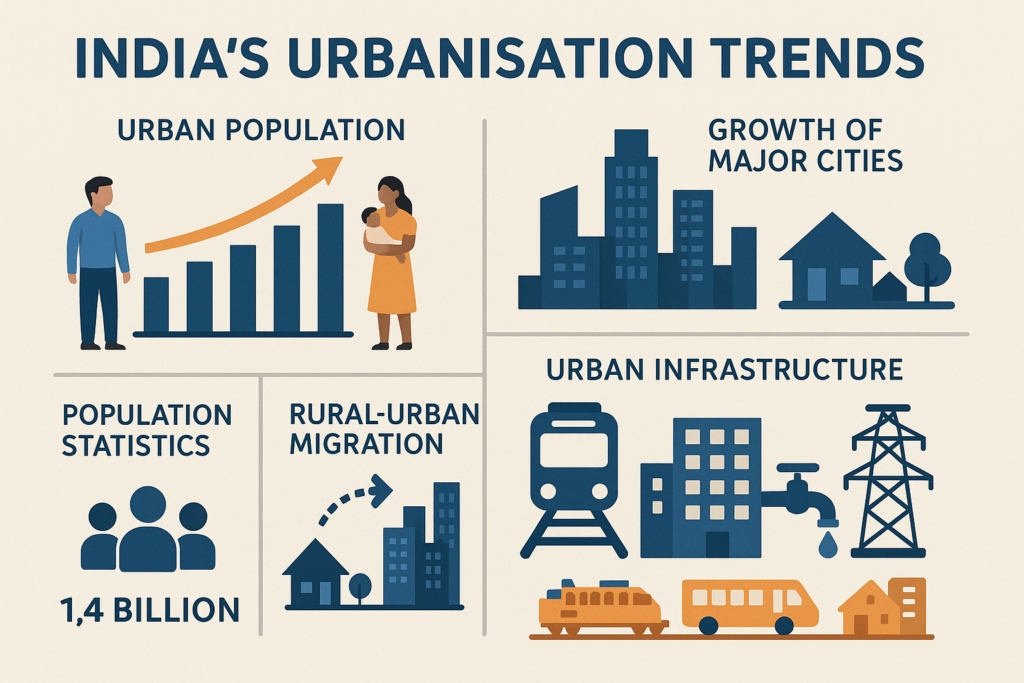
India stands at a critical urban inflection point, with projections indicating that 50% of the population will reside in cities by 2050 – a dramatic transformation from the current 36% urban population. This unprecedented demographic shift represents one of the world’s largest urbanisation movements, with India expected to add 416 million urban dwellers between 2018-2050, surpassing China’s projected urban growth. However, this rapid transformation has created a complex web of land acquisition challenges, housing shortages, environmental degradation, and governance failures that threaten sustainable development objectives. pib un
The Scale and Scope of India’s Urban Transformation
Current Urbanisation Statistics and Projections
India’s urban population reached 534.9 million in 2024, with urban areas contributing over 63% to GDP despite housing just over one-third of the population. The Economic Survey 2023-24 underscores that urban areas are projected to contribute 75% of GDP by 2030, making urban transformation essential for achieving Viksit Bharat 2047 goals.
Key Demographic Indicators:
- Urban population growth rate: 2.8% annually compared to 1.2% rural decline
- Number of census towns: Increased from 1,362 in 2001 to 3,894 in 2011
- Projected urban contribution to GDP: 75% by 2030 from current 63%
- Urban job creation potential: 70% of new employment opportunities
Spatial Patterns and Megacity Emergence
India’s urbanisation exhibits distinct spatial concentration patterns, with Delhi (28 million), Mumbai (22.1 million), and Bengaluru leading metropolitan growth. The phenomenon of “hyper-urbanisation” in these megacities has created unprecedented pressure on land resources and infrastructure systems.
Urban Growth Patterns:
- Peri-urban expansion: Transformation of agricultural land into informal settlements
- Census town proliferation: 3,894 census towns lack proper urban infrastructure despite urban characteristics
- Missing millions: Studies suggest 12% higher urban population than official statistics indicate pcmb.ncbi.nlm.nhi
- Metropolitan sprawl: Major cities expanding beyond administrative boundaries
The Housing Crisis: Quantifying India’s Urban Shelter Challenge
Massive Housing Shortage Statistics
India faces an acute urban housing shortage of 18.78 million units, with 76% concentrated in just ten states. This crisis disproportionately affects Economically Weaker Sections (EWS) and Low Income Groups (LIG), who constitute the majority of the urban poor. ijhssi
Housing Shortage Breakdown:
- Total urban housing shortage: 18.78 million units (Ministry of Housing and Urban Affairs)
- EWS category shortage: 10.55 million units (56% of total shortage)
- LIG category shortage: 7.41 million units (40% of total shortage)
- State-wise concentration: Uttar Pradesh leads with 3.07 million unit shortage
Slum Population and Informal Settlements
Slum Demographics and Growth:
- Total slum population: 65-98 million people (17-24% of urban population)
- Slum households: 13.92 million as per Census 2011, growing 37.1% from 2001
- Non-notified slums: 50% lack government recognition, creating barriers to basic services niti.gov
- Regional concentration: 15 large cities have 25-40% population in slums
The proliferation of informal settlements reflects the fundamental mismatch between urban employment opportunities and affordable housing availability, forcing low-income migrants into substandard living conditions without security of tenure.
Legal and Institutional Challenges in Land Governance
Land Acquisition Act 2013: Implementation Hurdles
The Right to Fair Compensation and Transparency in Land Acquisition, Rehabilitation and Resettlement Act 2013 introduced comprehensive reforms but faces significant implementation challenges affecting urban development projects. bhattandjoshiassociates
Key LARR Act Provisions:
- Social Impact Assessment (SIA) mandatory for all acquisitions
- 80% consent required for private company acquisitions
- 70% consent needed for Public-Private Partnership projects
- Enhanced compensation: 4x collector rate in rural areas, 2x in urban areas
Implementation Challenges:
- Procedural delays: Complex SIA requirements causing 6-12 month delays
- High compensation costs: Straining public and private project budgets
- State-level dilutions: Several states introduced amendments weakening provisions
- Social justice balance: Difficulty reconciling development needs with displacement rights
Land Title Ambiguities and Digital Records
Land Records Modernization:
- Digital India Land Records Modernization Program (DILRMP) shows uneven progress
- Outdated cadastral maps affecting 70% of urban areas
- Multiple agency jurisdiction creating coordination failures
- Corruption and speculation inflating land prices artificially
Environmental Consequences of Unplanned Urbanisation
Urban Heat Islands and Climate Impact
Indian cities face severe environmental degradation due to uncontrolled urban expansion. Research indicates nighttime Surface Urban Heat Island Intensity (SUHII) growth exceeding 0.007°C annually in major cities.
Climate Vulnerability Indicators:
- Air pollution levels: Delhi, Mumbai, Kolkata exceed WHO safety standards
- Economic cost of pollution: $95 billion annually (Clean Air Fund 2023)
- River contamination: 50% of 603 rivers polluted, critical in Yamuna and Ganga
- Wastewater treatment: Only 30% treated before disposal
Urban Flooding and Wetland Encroachment
Environmental Disasters:
- Chennai floods (2015): Caused by wetland encroachment and poor drainage
- Bengaluru urban flooding: Lake encroachment affecting natural water flow
- Groundwater depletion: Over-extraction and concretization reducing recharge
- Loss of green cover: Contributing to urban heat island effects
Government Initiatives and Implementation Status
Smart Cities Mission: Progress and Challenges
The Smart Cities Mission, launched in June 2015 with 100 cities, represents India’s most ambitious urban transformation program. mohua
Smart Cities Achievement Overview:
- Total investment: ₹1,71,086 crore across 8,010 projects
- Completed projects: 7,479 out of 8,058 tendered projects (93% completion rate)
- Smart governance projects: ₹14,758 crore investment completed
- Public space development: 1,167 projects completed with ₹4,062 crore investment
- WASH projects: 1,293 completed, 228 in pipeline
PMAY-U: Housing for All Achievement
Pradhan Mantri Awas Yojana-Urban Success Metrics:
- Total houses sanctioned: 1.18 crore across 4,618 ULBs
- Houses completed: 88.32 lakh delivered to beneficiaries
- Total investment: ₹8,07,393 crore with ₹2 lakh crore central assistance
- Women empowerment: 89 lakh houses in women’s names or joint ownership
- Social inclusion: 16 lakh houses for minorities, 23 lakh for SC/ST pib pmay-urban.gov
AMRUT Mission: Urban Infrastructure Development
Atal Mission for Rejuvenation and Urban Transformation Results:
- Completed projects: 5,163 projects worth ₹45,566 crore
- Ongoing works: 739 projects worth ₹39,381 crore
- Total physical work: ₹75,255 crore in completed/ongoing projects
- Central releases: ₹40,775 crore to States/UTs for implementation
- DPR approval: 4,558 projects worth ₹96,880 crore approved
Global Best Practices and Learning Opportunities
Singapore’s Public Housing Model
Singapore demonstrates exemplary public housing policy with ~80% population residing in government-built Housing Development Board (HDB) flats:
Singapore Success Factors:
- Land monetization: Public land leasing generates two-fifths of government revenue
- Integrated planning: Transit-oriented development with comprehensive amenities
- Ethnic integration: Racial quota system preventing segregation
- Affordability mechanisms: Subsidized ownership through CPF contributions
Japan’s Transit-Oriented Development
Japan’s TOD model successfully reduces land pressure while promoting sustainable urban growth:
Japanese TOD Features:
- Rail-plus-property development: Value capture financing for infrastructure
- Land readjustment: Comprehensive area development with stakeholder participation
- Mixed-use integration: Commercial and residential development around transit nodes
- Walkable neighborhoods: 15-minute city concepts reducing transportation needs
China’s Urban Land Leasing Model
China’s land leasing system provides innovative financing for urban infrastructure:
Chinese Model Elements:
- Land value capture: Development rights separation enabling flexible financing
- Infrastructure funding: Land lease revenues supporting metro construction
- Public-private coordination: Government-developer partnerships for integrated development
- Value creation: Transit investment increasing surrounding land values
Sustainable Solutions and Way Forward
Integrated Land-Use Planning Strategies
Transit-Oriented Development Implementation:
- Metro corridor development with mixed-use zoning reducing travel demand
- 15-minute neighborhood concept ensuring essential services within walking distance
- Vertical development policies maximizing Floor Space Index (FSI) in transit corridors
- Land value capture mechanisms financing infrastructure through development charges
Smart Urban Planning Innovations:
- GIS-based master planning for data-driven decision making
- Climate-resilient infrastructure incorporating disaster risk reduction
- Blue-green infrastructure including urban wetlands and green corridors
- Compact city development reducing urban sprawl and infrastructure costs
Affordable Housing and Social Equity
Inclusive Housing Strategies:
- Public rental housing programs for urban migrants and informal workers
- Cooperative housing models enabling community ownership and management
- Inclusionary zoning policies mandating affordable units in private developments
- Slum redevelopment through in-situ rehabilitation with community participation
Gender and Social Justice:
- Women’s property rights strengthening through joint ownership mandates
- Migrant housing rights ensuring tenure security for informal settlements
- Differently-abled accessibility in all urban housing projects
- Elderly-friendly housing with appropriate design and healthcare access
Strengthening Urban Local Bodies
Governance Reforms:
- Fiscal autonomy enhancement through municipal bond markets and property tax reforms
- Professional urban planning cadre development with specialized training programs
- Citizen participation mechanisms including ward committees and area sabhas
- Inter-agency coordination through unified metropolitan planning authorities
Digital Governance Integration:
- Unified property databases linking all urban services and tax collection
- AI-powered urban planning for predictive infrastructure needs assessment
- Citizen service portals enabling transparent grievance redressal
- Real-time monitoring systems for project implementation and service delivery
Environmental Sustainability and Climate Resilience
Green Infrastructure Development:
- Urban forest programs including Miyawaki forest techniques for rapid greening
- Rainwater harvesting mandates for all new constructions above specific areas
- Waste-to-energy plants and circular economy models reducing landfill pressure
- Electric mobility promotion through charging infrastructure and policy incentives
Climate Adaptation Measures:
- Flood-resilient infrastructure with improved drainage and retention systems
- Heat action plans including cooling centers and public awareness programs
- Green building certifications mandatory for government and large private buildings
- Urban microclimate management through strategic green space planning
Technology and Innovation Integration
Smart City Technologies:
- IoT sensor networks for traffic management, air quality monitoring, and waste collection
- Blockchain-based land records ensuring transparent and tamper-proof documentation
- Predictive analytics for infrastructure maintenance and resource optimization
- Mobile governance platforms enabling citizen engagement and service delivery
Financial Innovation:
- Municipal bond market development for infrastructure financing
- Public-private partnerships in housing, transportation, and utilities
- Impact investment funds targeting affordable housing and sustainable infrastructure
- Carbon credit mechanisms incentivizing green urban development
Conclusion: Building Sustainable Urban India
India’s urbanisation trajectory presents both unprecedented opportunities and formidable challenges that will determine the country’s development path for decades. The transformation of 416 million people from rural to urban areas by 2050 represents one of humanity’s largest demographic shifts, requiring innovative governance, sustainable planning, and inclusive development approaches.
Success will depend on:
- Proactive land governance reforms that balance development needs with social justice
- Technology-enabled planning that anticipates infrastructure needs and optimizes resource allocation
- Climate-resilient development that protects vulnerable populations while promoting economic growth
- Inclusive growth models that provide affordable housing and dignified employment for all urban residents
The lessons from Singapore’s public housing success, Japan’s transit-oriented development, and China’s land value capture mechanisms demonstrate that well-designed urban policies can transform challenges into opportunities. India’s Smart Cities Mission, PMAY-U, and AMRUT programs have laid strong foundations, but scaling success requires continuous innovation, improved coordination, and sustained political commitment.
As India stands at this urban inflection point, the choices made today will determine whether Indian cities become engines of prosperity and sustainability or centers of inequality and environmental degradation. The path forward demands collaborative effort between government, private sector, civil society, and citizens to build world-class cities that serve as models for sustainable urbanisation globally.
The urban India of 2050 must be environmentally sustainable, socially inclusive, economically productive, and technologically advanced – a vision that requires immediate action on land reforms, housing policies, infrastructure development, and governance transformation. Success in this endeavor will not only transform Indian cities but also contribute to global sustainable development goals and climate action.
🖊️ Mains Practice
Q1. Discuss the challenges posed by rapid urbanisation on land resources in India. Suggest reforms to ensure sustainable and equitable land-use planning. (250 words)
Q2. “Urbanisation in India is as much a challenge of governance as it is of land management.” Examine with suitable examples. (250 words)









+ There are no comments
Add yours