
Key Highlights:
- Gross NPAs in scheduled commercial banks surged from 2.5% in 2010-11 to 11.2% in 2017-18 with PSBs worst affected at 14.6% compared to private banks’ 4.7%, reflecting systemic issues in infrastructure lending
- Infrastructure sector contributed 50% of corporate debt defaults under IBBI insolvency resolution, with top 100 companies owing 43% of total NPAs worth ₹4.02 lakh crore as of March 2019
- PSBs received ₹4.03 trillion capital infusion between 2008-09 and 2021-22 including ₹2.11 trillion in 2017 recapitalization, undermining PPP’s primary objective of reducing fiscal pressure on government
- 40% of corporate debt owed by companies with interest coverage ratio less than 1 indicating inability to service even interest payments, creating twin balance sheet problem affecting both lenders and borrowers
- Development Finance Institutions phased out after 1990s reforms left commercial banks as primary infrastructure lenders, creating asset-liability mismatch between long-term projects and short-term deposits
The Infrastructure Paradox
Infrastructure development stands as the backbone of trade, industry, and economic growth, serving as the foundation for a nation’s prosperity and societal progress. In India, the financing of infrastructure projects has been a joint effort between government, private sector, and banks, with the introduction of Public-Private Partnerships (PPPs) in the late 1990s intended to enhance private sector participation and improve efficiency in infrastructure development.
However, the financial viability of these projects has been severely questioned due to the rising levels of Non-Performing Assets (NPAs) in the banking sector. The paradox is striking: PPPs designed to enhance efficiency and reduce fiscal burden ultimately resulted in rising NPAs that threatened banking sector stability and required massive government bailouts.
The numbers tell a devastating story: Gross NPAs in scheduled commercial banks surged from 2.5% in 2010-11 to 11.2% in 2017-18. Public Sector Banks (PSBs) were particularly affected, with NPAs reaching 14.6% compared to 4.7% for private banks. Infrastructure sector’s contribution to this crisis is undeniable: 50% of corporate debt defaults under IBBI insolvency resolution stem from infrastructure projects.
The twin balance sheet crisis of the 2010s represents one of the most significant challenges in India’s post-independence economic history, where both lenders and borrowers faced severe stress simultaneously. Understanding this crisis provides crucial insights into the complex relationship between infrastructure financing, banking sector health, and overall economic stability.
Historical Context: Evolution of Infrastructure Financing

Post-Independence Development Framework
Following independence in 1947, India’s infrastructure was largely underdeveloped, requiring significant public investment to build the foundation for economic growth. The government recognized that without adequate infrastructure, the country could not achieve sustainable development or improve living standards for its citizens.
Development Finance Institutions (DFIs) were established as specialized lenders to facilitate industrial and infrastructure growth: ris.org
Key DFIs and Their Roles:
- Industrial Development Bank of India (IDBI): Focused on industrial financing and long-term capital requirements
- Industrial Credit and Investment Corporation of India (ICICI): Private sector lending and project finance expertise
- Industrial Finance Corporation of India (IFCI): Term lending for industrial development
- Sector-specific institutions: Power Finance Corporation (PFC), Rural Electrification Corporation (REC), Small Industries Development Bank of India (SIDBI)
DFIs played a crucial role in promoting financing not only for industrial development but also sector-specific requirements, whether power sector development or rural electrification programs.
Financial Sector Reforms of the 1990s: The Turning Point
The financial sector reforms of the 1990s marked a fundamental shift in India’s infrastructure financing landscape. DFIs were gradually phased out, leaving commercial banks as primary lenders for infrastructure projects – a role for which they were not originally designed.
Consequences of DFI Phase-Out:
- Loss of specialized expertise in long-term project financing
- Asset-liability mismatch in commercial banks
- Reduced institutional capacity for infrastructure risk assessment
- Shift from patient capital to short-term funding approaches
The India Infrastructure Report (1996) projected a sevenfold increase in infrastructure investment requirements, highlighting the massive financing needs that would emerge. This supply-demand gap in infrastructure financing set the stage for the subsequent reliance on PPP models.
Introduction of PPP Model: Promise and Peril
The late 1990s witnessed the introduction of PPP models as a solution to infrastructure financing challenges. The government aimed to enhance private sector participation and share financial burdens while leveraging private sector efficiency and innovation.
PPP Model Objectives:
- Reduce fiscal burden on government
- Leverage private sector efficiency and management expertise
- Share risks between public and private partners
- Accelerate infrastructure development through increased investment
Private investment surge occurred between 2007 and 2014, with substantial capital flowing into infrastructure sectors. However, subsequent financial stress in these projects contributed significantly to the sharp rise in bank NPAs.
The Twin Balance Sheet Crisis: Magnitude and Scale
Defining the Crisis
The twin balance sheet crisis represents a two-fold problem: overleveraged companies unable to service debt and bad-loan-encumbered banks. This dual stress created a vicious cycle where weak companies could not repay loans, while stressed banks could not provide fresh credit to support economic growth. indiabudget.gov
The Economic Survey 2016-17 reported that around 40% of corporate debt was owed by companies with interest coverage ratio less than 1. This alarming statistic meant that these companies did not earn enough from their core operations to pay even the interest on their loans, let alone repay the principal.
Interest Coverage Ratio Analysis:
- Ratio > 1: Company earns enough to cover interest payments
- Ratio < 1: Company cannot service basic interest obligations
- 40% of corporate debt in the “less than 1” category indicates systemic stress
Quantifying the NPA Problem: Scale of Devastation
The scale of the NPA crisis can be quantified through multiple metrics that reveal the severity of the banking sector stress:
Sectoral NPA Growth:
- All Scheduled Commercial Banks: From 2.5% (2010-11) to 11.2% (2017-18)
- Public Sector Banks: 14.6% NPA ratio at peak
- Private Banks: 4.7% NPA ratio (significantly lower than PSBs)
- Foreign Banks: Relatively contained NPA levels
Infrastructure Sector’s Disproportionate Impact:
- 50% of corporate debt defaults under IBBI insolvency resolution from infrastructure sector
- Top 100 companies owed 43% of total NPAs (₹4.02 lakh crore as of March 2019)
- Power and roads sectors experienced severe financial stress
Concentration Risk Evidence:
More than four-fifths of non-performing assets were in public sector banks, where the NPA ratio reached almost 12%. This concentration in PSBs created systemic risks for the entire banking sector and broader economy.
Four Major Contributors to the NPA Crisis
1. Commodity Price Collapse: External Shock Impact
The fall in global commodity prices caused significant financial distress in metals and commodity-dependent sectors. Companies that had borrowed heavily during the commodity boom found themselves unable to service debt when prices collapsed and revenues declined sharply.
Impact Mechanisms:
- Revenue reduction due to lower commodity prices
- Fixed debt obligations becoming unsustainable relative to reduced cash flows
- Working capital constraints affecting operational efficiency
- Asset value deterioration reducing collateral coverage
2. Regulatory Forbearance: Delayed Recognition
Prolonged regulatory forbearance allowed unsustainable credit exposure to continue unchecked. Banks were permitted to avoid classifying stressed assets as NPAs through various schemes and restructuring mechanisms, delaying recognition of the true extent of the crisis.
Forbearance Mechanisms:
- Corporate Debt Restructuring (CDR) schemes
- Strategic Debt Restructuring (SDR) options
- Scheme for Sustainable Structuring of Stressed Assets (S4A)
- Flexible structuring of long-term project loans
Consequences of Delayed Recognition:
- Masking true extent of banking sector stress
- Continued lending to unviable projects
- Accumulation of stress over multiple years
- Reduced credibility of banking sector reporting
3. Corporate Governance Failures: System Weakness
Governance deficiencies in both banks and borrowing firms contributed significantly to the NPA crisis. Lack of accountability and weak internal controls created conditions conducive to poor lending decisions and project management failures.
Bank-Level Governance Issues:
- Inadequate credit appraisal processes
- Poor post-lending monitoring mechanisms
- Political interference in lending decisions
- Insufficient risk management frameworks
Corporate-Level Governance Problems:
- Aggressive expansion strategies without adequate risk assessment
- Over-leveraging beyond sustainable debt capacity
- Inadequate project execution capabilities
- Poor financial reporting and transparency
4. PPP Infrastructure Project Failures: Model Breakdown
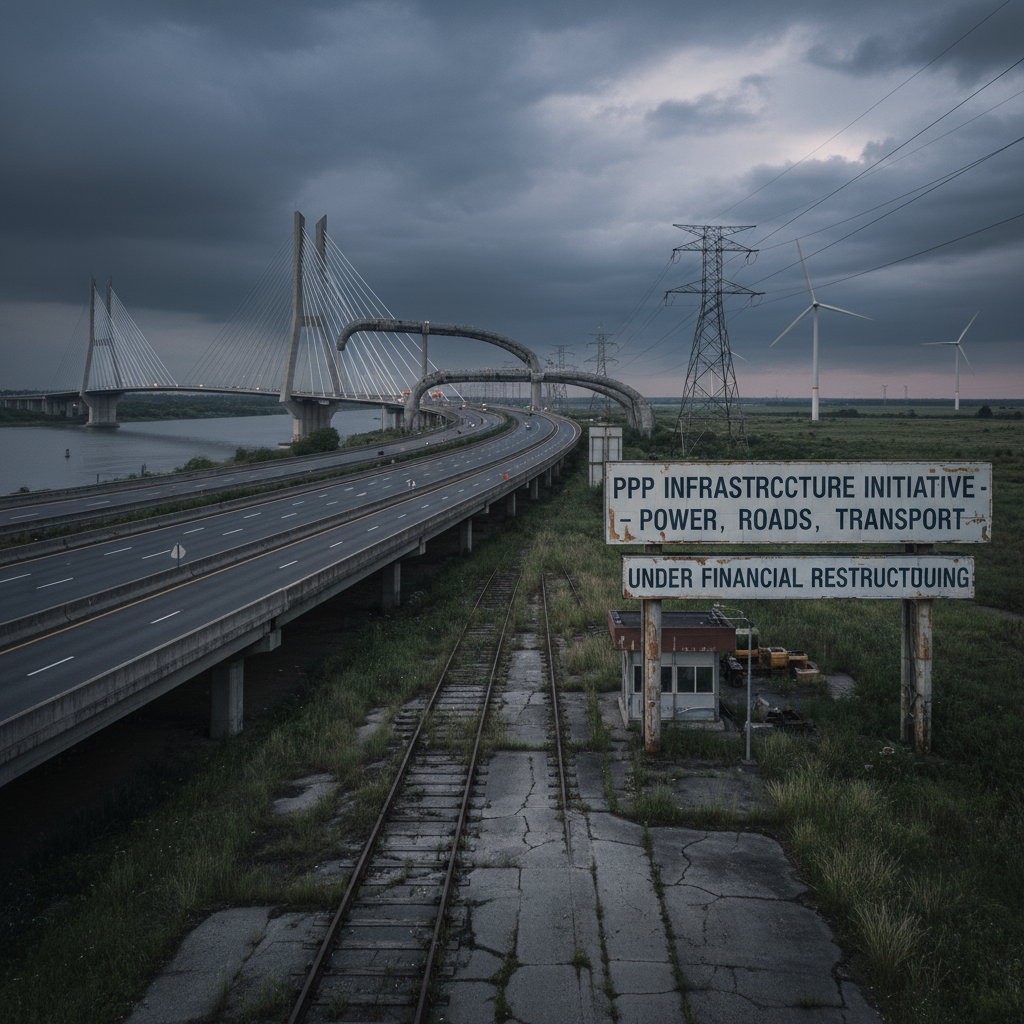
Severe financial stress particularly in power and roads sectors represented fundamental flaws in the PPP model implementation. Cost overruns, project delays, and maintenance issues plagued numerous infrastructure projects, contradicting the efficiency promises that justified the PPP approach.
Power Sector Specific Challenges:
- Overcapacity due to overestimation of electricity demand
- Fuel supply disruptions and coal shortages affecting plant operations
- Lack of long-term Power Purchase Agreements (PPAs) creating revenue uncertainty
- Financial distress of Distribution Companies (DisComs) causing cascading payment delays
Roads, Highways, and Bridges Issues:
- Land acquisition delays hampering project timelines
- Slow environmental clearance processes creating implementation bottlenecks
- Over-leveraging by private developers without adequate equity contribution
- Unrealistic traffic volume projections leading to revenue shortfalls
Bank Lending Patterns and Sectoral Analysis
Dominance of Bank Financing and Market Failures
Indian banks emerged as dominant corporate credit providers, with infrastructure absorbing significant share of non-food credit. Unlike developed economies where bond markets play substantial roles in infrastructure financing, India’s underdeveloped corporate bond market constrained alternative funding sources.
Financing Structure Comparison:
- Developed economies: Bond markets provide 30-50% of infrastructure financing
- India: Bank lending dominates with limited bond market participation
- Alternative financing: Insurance companies, pension funds have minimal participation
Asset-Liability Mismatch Problems:
Long gestation periods of infrastructure projects (often 15-25 years) were funded through short-term bank deposits (typically 1-5 years), creating fundamental structural imbalances.
PSB vs. Private Bank Lending: Differential Approaches
Public Sector Banks disproportionately lent to infrastructure projects compared to private banks. Analysis of lending patterns reveals significant differences in approach and outcomes between PSBs and private banks.
Lending Decision Analysis Findings:
- PSB-selected firms had healthier pre-lending financial conditions than private bank choices
- Post-lending deterioration was significantly more pronounced for PSB-backed firms
- Evidence suggests weak monitoring rather than poor initial screening as the primary problem
This analysis indicates that PSBs were not necessarily worse at initial project selection but failed dramatically in post-lending monitoring and corrective action when projects encountered difficulties.
Structural Challenges in Infrastructure Sectors
Power Sector: The Perfect Storm
Power sector challenges created multiple stress points that converged to generate massive NPAs in banking system:
Overcapacity Crisis:
- Overestimation of electricity demand led to excess capacity creation
- Stranded assets with limited revenue generation capability
- Fixed costs continuing regardless of capacity utilization
Fuel Supply Disruptions:
- Coal shortages affecting thermal power plants
- Environmental clearance delays for mining projects
- Transportation bottlenecks in coal supply chains
Revenue Model Breakdown:
- Lack of long-term PPAs with state electricity boards
- Financial distress of DisComs creating payment delays
- Regulatory uncertainty in tariff determination
Roads and Highways: Implementation Failures
Roads, highways, and bridges sector faced unique challenges that contributed significantly to infrastructure NPAs:
Land Acquisition Bottlenecks:
- Complex legal processes for land acquisition
- Local resistance and compensation disputes
- Court cases and legal delays extending project timelines
Environmental Clearance Issues:
- Slow clearance processes from multiple agencies
- Environmental impact assessments taking excessive time
- Clearance conditions increasing project costs
Financial Structure Problems:
- Over-leveraging by developers seeking to maximize returns
- Unrealistic traffic projections for toll revenue calculations
- Inadequate equity contribution from private partners
Government Response: Bank Recapitalization

Scale of Capital Infusion
The failure of large infrastructure projects and rising NPAs led to successive rounds of bank recapitalization by the government. Between 2008-09 and 2021-22, PSBs received capital infusions totaling ₹4.03 trillion – an unprecedented bailout in India’s banking history.
Major Recapitalization Programs:
- Indradhanush Plan (2015): Estimated ₹1.8 trillion capital support required for PSBs
- 2017 Recapitalization: ₹2.11 trillion earmarked, primarily through recapitalization bonds
- Multiple smaller infusions: Throughout the crisis period
Fiscal Implications and Policy Contradictions
The necessity of recapitalizing banks undermines the primary PPP objective of reducing fiscal pressure on the government. Much of the financial burden has shifted back to the public sector, raising fundamental questions about the effectiveness of infrastructure financing strategies.
Policy Contradiction Analysis:
- PPP objective: Reduce government fiscal burden
- Actual outcome: Massive government bailout of failing private projects
- Net fiscal impact: Higher government expenditure than traditional public financing
Additional Government Initiatives for NPA Resolution
Insolvency and Bankruptcy Code (IBC) 2016
The IBC 2016 introduced a time-bound resolution process for stressed assets, empowering creditors to initiate insolvency proceedings against defaulting companies. This represented a paradigm shift from debtor-friendly to creditor-empowering framework.
IBC Key Features:
- 180-day resolution timeline (extendable to 270 days)
- Committee of Creditors empowerment in decision-making
- National Company Law Tribunal (NCLT) as adjudicating authority
- Liquidation as final option if resolution fails
4R Strategy: Comprehensive Approach
Government adopted a comprehensive 4R strategy:
- Recognition: Asset Quality Review (AQR) for accurate NPA identification
- Resolution: Time-bound resolution through IBC and other mechanisms
- Recapitalization: Capital infusion to strengthen bank balance sheets
- Reforms: Governance and operational improvements in banking sector
Bad Bank Concept: Asset Aggregation
National Asset Reconstruction Company Limited (NARCL) was established to aggregate and consolidate stressed assets from multiple banks, enabling specialized resolution and recovery processes.
Policy Recommendations: Learning from Crisis
Strengthening Alternative Infrastructure Financing
Developing deeper corporate bond markets is crucial to reduce dependency on bank lending for infrastructure projects:
Bond Market Development Priorities:
- Regulatory frameworks supporting long-term bond issuances
- Credit rating agencies with infrastructure expertise
- Market makers providing liquidity for infrastructure bonds
- Tax incentives for infrastructure bond investments
Institutional Investor Participation:
Encouraging insurance companies and pension funds to participate actively in infrastructure financing. Currently only 2% of Indian pension fund assets are invested in infrastructure compared to higher global benchmarks.
Improving Project Appraisal and Monitoring
Enhanced due diligence in infrastructure lending by banks and stricter post-lending monitoring mechanisms are essential for ensuring financial discipline:
Due Diligence Improvements:
- Comprehensive feasibility studies accurately assessing project viability
- Realistic demand projections based on robust market analysis
- Thorough risk assessment including regulatory and environmental risks
- Adequate equity requirements ensuring promoter commitment
Monitoring Mechanisms:
- Regular project reviews and milestone monitoring
- Early warning systems for identifying project distress
- Corrective action protocols for addressing emerging issues
- Performance-based lending linking disbursements to milestones
Reforming the PPP Model
Fundamental PPP model reforms are required to address structural weaknesses:
Risk Allocation Framework:
- Appropriate risk sharing between public and private partners
- Government guarantees limited to specific, well-defined risks
- Force majeure clauses protecting against unforeseeable events
- Revenue model clarity reducing uncertainty for private investors
Contract Structure Improvements:
- Dynamic contract terms adjusting to changing circumstances
- Performance incentives aligning private partner interests with public objectives
- Transparent dispute resolution mechanisms
- Regular contract reviews and renegotiation options
Revamping Bank Governance and Incentives
Improving governance frameworks within PSBs to enhance lending decisions and aligning lending incentives with project performance rather than disbursement targets:
Governance Reforms:
- Professional management with operational autonomy
- Board independence from political interference
- Performance-based compensation for senior management
- Accountability mechanisms for lending decisions
Incentive Alignment:
- Risk-adjusted performance measurement for loan officers
- Long-term incentives linked to portfolio performance
- Claw-back provisions for compensation in case of loan defaults
Strengthening Specialized Financial Institutions
National Bank for Financing Infrastructure and Development (NaBFID) and India Infrastructure Finance Company Ltd. (IIFCL) need strengthening to better assess long-term infrastructure risks:
NaBFID Enhancement:
- Adequate capitalization for large infrastructure projects
- Specialized expertise in infrastructure risk assessment
- Credit enhancement instruments to attract private investment
- Long-term funding sources matching project lifecycles
DFI Revival Considerations:
- Learning from past DFI failures and incorporating modern safeguards
- Professional management with commercial orientation
- Diversified funding sources beyond government support
- Regulatory oversight ensuring prudent operations
Lessons and Way Forward
Balancing Growth and Stability
Infrastructure development remains crucial for economic growth but must not compromise banking sector stability. Need for diversified financing ecosystem that reduces concentration risk in any single source of funding.
Diversification Strategies:
- Multiple funding sources: Banks, bonds, institutional investors, international finance
- Risk distribution: Across different types of lenders and investors
- Product innovation: Infrastructure Investment Trusts (InvITs), Real Estate Investment Trusts (REITs)
- International capital: Sovereign Wealth Funds, pension funds from developed countries
Institutional Reforms: Building Capacity
Strengthening financial oversight and regulatory mechanisms while building specialized institutions with expertise in long-term infrastructure financing:
Regulatory Enhancements:
- Macroprudential supervision monitoring systemic risks from infrastructure lending
- Sector-specific guidelines for different infrastructure segments
- Stress testing incorporating infrastructure-specific scenarios
- International coordination on regulatory best practices
Risk Management: Learning from Failures
Improved risk management strategies at both project and portfolio levels with realistic demand forecasting and revenue projections:
Project-Level Risk Management:
- Comprehensive risk identification and mitigation strategies
- Contingency planning for various stress scenarios
- Regular risk reassessment throughout project lifecycle
- Stakeholder alignment on risk management protocols
Portfolio-Level Risk Management:
- Diversification across sectors, geographies, and project types
- Concentration limits preventing excessive exposure to single sectors
- Correlation analysis understanding interconnected risks
- Economic cycle considerations in lending strategies
Conclusion: Rebuilding Infrastructure Finance Architecture
The twin balance sheet crisis of the 2010s serves as a stark reminder of the critical relationship between infrastructure financing decisions and overall financial stability. Infrastructure sector’s 50% contribution to corporate debt defaults reveals systemic issues that require comprehensive solutions extending beyond simple recapitalization efforts.
The scale of the crisis is undeniable: NPAs surging from 2.5% to 11.2%, PSBs requiring ₹4.03 trillion recapitalization, and 40% of corporate debt held by companies unable to service interest payments. These numbers represent not just statistical failures but real economic costs that ultimately burden taxpayers and slow national development.
The fundamental lesson is that infrastructure development and banking sector health are inextricably linked. Poor project selection, inadequate monitoring, and structural model flaws in PPP arrangements can transform infrastructure assets into banking liabilities that threaten systemic stability. The promise of private sector efficiency cannot override the need for rigorous financial discipline and appropriate risk management.
The path forward requires fundamental reforms in multiple dimensions: developing alternative financing sources like corporate bond markets, strengthening institutional capacity through organizations like NaBFID, improving project appraisal and monitoring, and reforming PPP models to ensure appropriate risk sharing. Simply returning to traditional government financing is not the solution – rather, learning from failures to design more robust public-private partnerships becomes essential.
For UPSC aspirants and policymakers, this crisis illustrates the complexity of infrastructure financing in developing economies. Success requires balancing growth imperatives with financial stability, private sector participation with public oversight, and innovation with prudential regulation. Understanding these trade-offs and designing appropriate institutional mechanisms will determine whether India can achieve its infrastructure development goals without repeating the mistakes of the 2010s.
The stakes remain high: India’s infrastructure needs continue to grow exponentially, requiring hundreds of billions in investment over coming decades. Getting the financing model right is not just about banking sector health but about whether India can build the infrastructure foundation necessary for sustained economic growth and improved living standards for its citizens.









+ There are no comments
Add yours