Key Highlights
- 2025 India-Pakistan crisis demonstrates continued terrorism threats and India’s shift toward proactive military deterrence against cross-border attacks
- China’s systematic regional expansion through BRI investments creates debt dependencies and strategic leverage across all major South Asian neighbors
- Multiple unresolved border disputes with China (Demchok, Depsang), Pakistan (Kashmir), and Nepal (Kalapani) maintain persistent tension flashpoints
- Water sharing conflicts with Bangladesh (Teesta) and Pakistan (Indus) intensify due to climate change and terrorism linkages
- Regional integration paralyzed by India-Pakistan tensions and Chinese influence, limiting South Asia’s collective economic potential
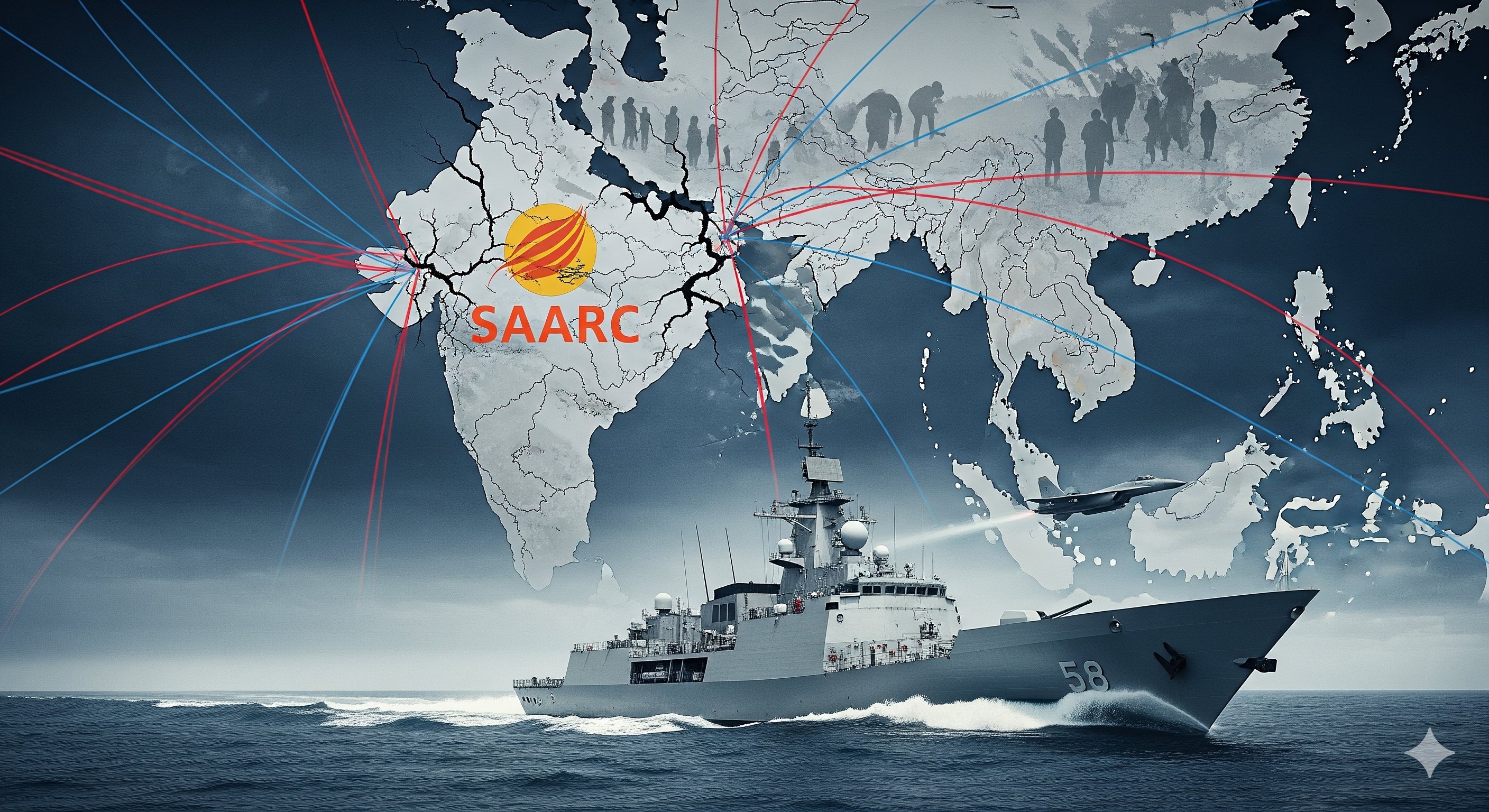
India’s strategic geography places it at the center of one of the world’s most volatile regions, where historical grievances, territorial disputes, and great power competition converge to create persistent security and diplomatic challenges. The 2025 India-Pakistan crisis following the Pahalgam attack, ongoing China-India border tensions, and shifting allegiances across South Asia underscore the complexity of managing relationships with immediate neighbors who are simultaneously strategic partners and security concerns. asiapacific cfr
Pakistan: The Persistent Strategic Challenge
The 2025 Escalation and New Security Doctrine
The April 22, 2025 Pahalgam attack that killed 26 civilians including 25 Indian tourists triggered the most significant India-Pakistan confrontation since 2019, culminating in Operation Sindoor on May 7. This crisis revealed both the fragility of bilateral relations and India’s evolving strategic approach to cross-border terrorism.
Key Crisis Developments:
- The Resistance Front (TRF) claimed responsibility for the deadliest terrorist attack since 2008 Mumbai attacks
- India suspended the Indus Waters Treaty and terminated visa-free travel regime
- Operation Sindoor targeted nine locations across Pakistan and PoK, allegedly killing 100 terrorists
- Pakistan retaliated with Operation Bunyan-um-Marsoos, leading to four days of intensive shelling
- Ceasefire achieved on May 10, 2025 following international pressure
India’s New Strategic Doctrine:
Prime Minister Modi articulated a “new doctrine” treating terrorist attacks as “acts of war” warranting military retaliation, signaling India’s departure from restraint-based approaches. This shift reflects growing impatience with nuclear blackmail and commitment to proactive deterrence. icct
Structural Issues in India-Pakistan Relations
Security Challenges:
- Cross-border terrorism remains the primary irritant with Pakistan-based groups continuing operations
- Kashmir dispute intensified after Article 370 revocation in August 2019
- Military establishment dominance in Pakistan politics prevents sustainable peace processes eparjournals journalpsa
Water and Economic Dimensions:
- Indus Waters Treaty suspension (first since 1960) over terrorism concerns
- Trade potential of $37 billion remains unrealized due to political tensions
- Economic interdependence limited by security considerations
China: The Strategic Competitor
Border Disputes and Recent Developments
The 2020 Galwan Valley clash fundamentally altered India-China relations, with over 100,000 troops deployed on both sides of the 3,488 km Line of Actual Control. Despite recent patrolling agreements in October 2024, significant challenges remain unresolved. carnegieendowmen
Current Border Status:
- Five friction points resolved: Galwan Valley, Pangong Tso, Gogra-Hot Springs through verified disengagement
- Two critical areas remain disputed: Demchok and Depsang Plains continue as flashpoints
- Infrastructure development race: Both nations invested heavily in border infrastructure and 50,000-60,000 troops stationed along LAC
Economic and Strategic Competition:
- Trade imbalance of approximately $85 billion in China’s favor
- China-Pakistan Economic Corridor (CPEC) through Pakistan-occupied Kashmir challenges India’s territorial claims
- String of Pearls strategy in Indian Ocean through ports in Gwadar, Hambantota, and Djibouti chellaney
Nepal: The China Factor and Border Disputes
Shifting Allegiances Under Chinese Influence
Nepal’s relationship with India has been significantly impacted by China’s Belt and Road Initiative, with Beijing offering $2.75 billion for trans-Himalayan connectivity projects. socialsciencejournal
Chinese Infrastructure Investments:
- Pokhara International Airport and Lumbini International Airport completed
- Trans-Himalayan Railway connecting Tibet with Nepal under development
- Keyrung-Kathmandu highway and multiple hydropower projects
- Access to four Chinese ports offered to reduce Nepal’s dependence on India
Kalapani Border Dispute:
- Constitutional inclusion of Kalapani, Lipulekh, and Limpiyadhura in Nepal’s 2020 constitution
- Territorial claims affecting 335 square kilometers along the India-Nepal border
- Historical treaties including Sugauli Treaty of 1816 remain contentious
Political Implications:
China’s influence contributed to political polarization, with communist parties advocating stronger China ties while pro-India parties face electoral challenges.
Bangladesh: Balancing Act Amid Growing Pressures
Water Disputes and Refugee Challenges
Despite historically strong ties, India-Bangladesh relations face persistent structural challenges that could destabilize the partnership:
Teesta River Dispute:
- Delayed water-sharing agreement since 2011 due to West Bengal’s objections
- Bangladesh requires Teesta waters during December-April for irrigation
- Technical team deployment agreed in June 2024 for mega conservation project
Rohingya Crisis Impact:
- Over one million Rohingya refugees in Bangladesh create regional instability
- Indian refusal to accept Rohingya refugees strains bilateral relations
- Security concerns about jihadist infiltration through refugee populations questjournals
Growing Chinese Influence:
- $24 billion Chinese investment in Bangladesh infrastructure
- Padma Bridge and other mega projects reduce Indian dependence
- Regional Comprehensive Economic Partnership (RCEP) interest despite India’s withdrawal
Sri Lanka: Economic Crisis and Debt Diplomacy
The Hambantota Port Controversy
Sri Lanka’s 2022 economic collapse highlighted vulnerabilities in Chinese debt diplomacy, though the “debt trap” narrative requires nuanced analysis:
Hambantota Port Reality:
- $1.3 billion Chinese loans represented only 4.8% of total external debt
- Commercial lease (not seizure) to China Merchants Port for $1.2 billion
- Sri Lankan initiative to raise foreign exchange, not Chinese coercion
- No debt forgiveness provided; existing obligations remain groundviews
Current Economic Dynamics:
- Chinese debt comprising 9% of government debt (excluding SOEs)
- IMF bailout conditions required reducing state enterprise losses
- Port now profitable with 700,000 vehicle units monthly turnover
Maldives: The “India Out” Challenge
Strategic Oscillation Between India and China
President Mohamed Muizzu’s 2023 electoral victory on an “India Out” platform created significant diplomatic challenges, though recent developments suggest tactical recalibration:
Initial Anti-India Stance:
- Indian military personnel withdrawal demanded immediately after election
- Strengthened China ties through defense agreements and $400 million projects
- “India Out” campaign resonated with sovereignty concerns over Indian presence
Economic Reality Check:
- Severe budget deficit and dwindling foreign reserves forced policy moderation
- Indian $400 million currency swap and $565 million line of credit crucial for stability
- 40% debt repayment burden reduction through Indian assistance
Strategic Recalibration:
Muizzu’s October 2024 India visit marked significant diplomatic shift, calling India a “trusted friend” and Modi a “wonderful person” – remarkable transformation from earlier rhetoric.
Afghanistan and Myanmar: Extended Neighbourhood Challenges
Taliban Rule and Regional Security
Afghanistan under Taliban:
- Terrorist safe havens for groups like Haqqani Network and ISIS-K
- Indian investments worth $3 billion in infrastructure at risk
- Humanitarian crisis affecting regional stability
- Pakistan’s support for Taliban complicating regional dynamics
Myanmar’s Military Coup Impact
Civil War Consequences:
- Military coup in February 2021 destabilized India’s Act East Policy
- Refugee influx into Mizoram and Manipur creating humanitarian challenges
- Insurgent sanctuaries along India-Myanmar border affecting Northeast security
- Chinese investments in Kyaukpyu port challenging Indian influence
Cross-Cutting Strategic Challenges
China’s Expanding Regional Footprint
China’s systematic expansion across South Asia through economic statecraft poses the most significant long-term challenge to Indian influence:
Belt and Road Initiative Impact:
- Pakistan: $62 billion CPEC creating deep strategic partnership
- Sri Lanka: Major port and infrastructure investments
- Nepal: $2.75 billion trans-Himalayan connectivity projects
- Bangladesh: $24 billion development assistance
- Maldives: Strategic infrastructure and defense cooperation
Regional Integration Paralysis
SAARC Dysfunction:
- India-Pakistan tensions paralyzing regional cooperation
- Last summit in 2014 with subsequent meetings cancelled
- Trade potential unrealized due to political conflicts
- Alternative forums like BIMSTEC and BBIN showing limited progress
Water Security and Climate Challenges
Transboundary River Disputes:
- Indus Waters Treaty under strain due to terrorism linkages
- Teesta sharing with Bangladesh pending for over a decade
- Ganga-Brahmaputra system affecting multiple countries
- Climate change intensifying water scarcity and disputes
India’s Strategic Response Framework
Neighbourhood First Policy Evolution
India’s Neighbourhood First Policy launched in 2014 has shown mixed results, requiring strategic recalibration:
Policy Achievements:
- Development assistance exceeding $3 billion annually
- Connectivity projects like Kaladan Multi-Modal Transit Transport
- Disaster relief during COVID-19 pandemic and natural calamities
- Cultural diplomacy through yoga, Bollywood, and educational exchanges
Policy Limitations:
- China’s economic superiority in infrastructure financing
- Domestic political considerations limiting Indian flexibility
- “Big Brother” perceptions affecting smaller neighbor relations
- Crisis-driven engagement rather than sustained strategic partnerships
SAGAR Vision and Maritime Strategy
India’s Security and Growth for All in the Region (SAGAR) vision emphasizes maritime cooperation and Indian Ocean security:
Maritime Initiatives:
- Information Fusion Centre for maritime domain awareness
- Coastal surveillance radar networks across Indian Ocean littorals
- Humanitarian assistance and disaster relief capabilities
- Blue economy partnerships with island nations
Strategic Way Forward: Comprehensive Neighborhood Engagement
Enhanced Economic Statecraft
Infrastructure Diplomacy:
- Accelerated connectivity projects through Kaladan Corridor and BBIN Motor Vehicle Agreement
- Digital infrastructure partnerships leveraging India Stack technologies
- Green energy cooperation through International Solar Alliance expansion
- Manufacturing hubs development through Production Linked Incentive schemes
Institutional Architecture Strengthening
Alternative Regional Frameworks:
- BIMSTEC revitalization with sector-specific partnerships
- Indian Ocean Rim Association (IORA) expansion for maritime cooperation
- Quad partnership integration with Indo-Pacific strategy
- Bilateral comprehensive partnerships replacing multilateral dependence
Technology and Innovation Diplomacy
Digital Governance Partnerships:
- Unified Payments Interface (UPI) integration across the region
- Telemedicine and e-education platforms for capacity building
- Disaster management systems using artificial intelligence and satellite technology
- Cybersecurity cooperation against transnational threats
Security Cooperation Enhancement
Counter-Terrorism Frameworks:
- Intelligence sharing mechanisms for terrorist movement tracking
- Border management technology including smart fencing and biometric systems
- Maritime security coordination through information sharing centers
- Defense industrial cooperation for equipment standardization
Climate and Water Diplomacy
Sustainable Resource Management:
- Joint river management authorities with scientific water sharing formulas
- Climate adaptation partnerships for Himalayan glacier monitoring
- Renewable energy cooperation through solar and hydropower projects
- Disaster resilience building through early warning systems
People-to-People Connectivity
Cultural and Educational Bridges:
- Visa liberalization for students, researchers, and entrepreneurs
- Language promotion through Hindi and Sanskrit teaching programs
- Cultural festivals and film co-productions for soft power projection
- Diaspora engagement as diplomatic multipliers
India’s neighborhood challenges require sophisticated strategic thinking that balances competitive geopolitics with cooperative development. The region’s future depends on whether India can overcome historical grievances, counter Chinese influence through superior economic partnerships, and build inclusive regional institutions that serve collective prosperity.
Success demands moving beyond crisis management to proactive relationship building, leveraging technology for innovative solutions, and maintaining strategic patience while defending core national interests. The stakes could not be higher – a stable, prosperous South Asia integrated under Indian leadership versus a fragmented region dominated by external powers and perpetual conflict.
The path forward requires domestic political consensus, bureaucratic coordination, resource allocation, and diplomatic creativity to transform troubled relationships into strategic partnerships that serve 21st-century aspirations of peace, prosperity, and regional leadership.
Mains
- “India’s neighbourhood is becoming the new frontier of China–India rivalry.” Discuss with examples.
- “India’s ‘Neighbourhood First’ policy has been more rhetoric than reality.” Critically examine.
- How do domestic instabilities in South Asian neighbours affect India’s security and foreign policy? Illustrate with examples.









+ There are no comments
Add yours