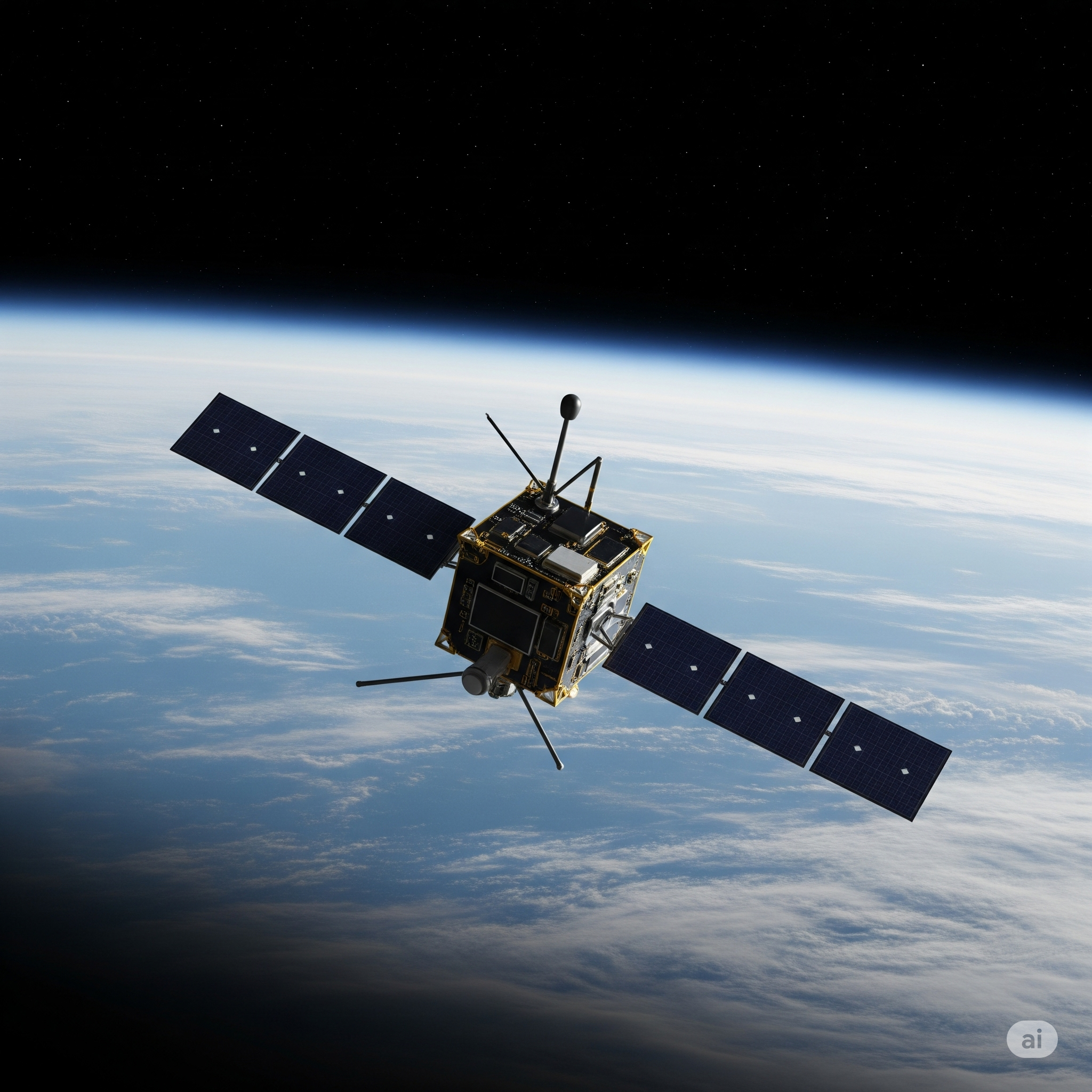
A New Space Age—Small but Powerful
Space exploration was once a pursuit only wealthy nations and billion-dollar agencies could afford. Today, that’s changing fast.
Enter CubeSats and nanosatellites—tiny, cost-effective, and agile satellites that are revolutionizing the way we explore space, collect data, and run tech experiments in orbit.
These mini marvels are making space accessible to startups, universities, and even high school students, fueling innovation in communication, Earth observation, weather forecasting, and deep-space research.
🔍 What Are CubeSats and Nanosatellites?
📦 CubeSats: Definition and Format
A CubeSat is a type of nanosatellite with standardized dimensions of 10x10x10 cm, known as 1U. They can be combined:
- 1U = basic single unit
- 3U = elongated, about the size of a loaf of bread
- 6U and 12U = more advanced missions
They typically weigh less than 1.33 kg per unit (U).
🛰️ Nanosatellites: The Category
Nanosatellites generally refer to satellites weighing between 1 kg and 10 kg. CubeSats are a subset of nanosatellites, but not all nanosats follow the CubeSat form factor.
These satellites ride to space as “secondary payloads”, hitchhiking on rockets with larger missions—drastically reducing launch costs.
💡 Why CubeSats and Nanosatellites Matter
1. Cost-Effective Missions
Traditional satellite missions can cost hundreds of millions of dollars. A CubeSat mission, including manufacturing and launch, may cost as little as $100,000 to $1 million.
2. Rapid Development
- Can be built and launched in months, compared to years for traditional satellites.
- Use off-the-shelf components for faster iteration.
3. Democratizing Space
- Accessible to students, universities, and small nations
- Encourages STEM innovation and experimentation
- Acts as a test bed for new technologies (AI, mini-cameras, sensors)
🌐 Real-World Applications of CubeSats
| Application | Description & Example |
|---|---|
| 🌍 Earth Observation | Monitoring crops, forests, pollution (e.g., Planet Labs’ fleet) |
| 📡 Communication | Low-cost data relays in rural or disaster-hit areas |
| 🔭 Deep Space Missions | Interplanetary missions like NASA’s MarCO CubeSats to Mars |
| 🎓 Education & R&D | University-led missions (e.g., India’s STUDSAT, IIT Bombay’s Pratham) |
| 🛰️ Tech Demos | Testing propulsion, sensors, miniaturized electronics |
🌍 Case Study: Planet Labs – Monitoring Earth Daily with CubeSats
- Operates over 200 Dove CubeSats in Low Earth Orbit
- Provides daily high-resolution images of every spot on Earth
- Applications: Urban planning, agriculture, forestry, disaster monitoring
This commercial model of “data-as-a-service” proves that small satellites can power billion-dollar industries.
🇮🇳 India’s CubeSat Efforts
India is catching up fast with ISRO’s Anusat, Youthsat, and academic missions:
🛰️ STUDSAT (2010)
- Developed by 7 Indian engineering colleges
- First pico-satellite (less than 1 kg) built by students
- Demonstrated India’s student-led capacity in space tech
🛰️ Pratham (IIT Bombay)
- Aimed to measure Total Electron Count (TEC) in the ionosphere
- Showcased precision even in academic builds
ISRO’s 2024 small satellite launch vehicle (SSLV) makes it even easier to deploy these types of missions affordably.
🧪 How Are CubeSats Built?
Most CubeSats follow a modular architecture with:
- Power system: Solar panels + lithium batteries
- OBC (Onboard computer): Raspberry Pi or custom boards
- ADCS (Attitude control): Magnetometers, gyroscopes, sometimes no thrusters
- Communication module: UHF/VHF antennas
- Payload: Camera, spectrometer, or experiment module
Some satellites even use AI chips for real-time onboard processing, like image filtering or anomaly detection.
⚠️ Limitations and Challenges
Despite their promise, CubeSats aren’t perfect.
| Challenge | Explanation |
|---|---|
| 🔋 Limited Power | Small surface = fewer solar panels = energy constraints |
| 🧭 Minimal Control | Some lack attitude control, drift easily in orbit |
| 💥 Space Debris Risk | Many lack deorbit plans, adding to orbital junk |
| 🔄 Short Lifespan | Usually 1–3 years, then burn up or go dead |
| 📶 Bandwidth Limitations | Data transfer is limited due to small antenna size |
That said, innovations like deployable solar wings, mini thrusters, and laser comms are solving many of these issues.
🛰️ The Future: Smart, Swarming, Self-Healing Satellites
The next decade will witness:
- Swarm satellite networks: Multiple CubeSats working together for imaging or communications
- AI-powered nanosats: Able to make real-time decisions
- Reusable CubeSat buses: Faster, plug-and-play configurations
- Biodegradable satellites: To reduce orbital debris
- 3D-printed satellites: To reduce cost and increase build speed
India, Europe, and Africa are rapidly investing in CubeSat manufacturing hubs and educational missions.
🔭 Final Thoughts: Small Packages, Giant Leaps
The space race is no longer just about who goes farther—it’s also about who goes smarter.
CubeSats and nanosatellites are changing the narrative from rocket science for the elite to innovation at your fingertips. With every tiny satellite launched, we edge closer to a more inclusive, innovative, and sustainable space ecosystem.
🚀 “Not all great missions need to be massive—some just need a cube and a dream.”







+ There are no comments
Add yours